Genotypes and haplotypes describe chromosome copies in an individual. A pedigree records the parentage links that explain how chromosome segments can pass among individuals. It lets a breeding programme distinguish a close relative from an unrelated candidate before any relationship matrix is calculated. The previous page described transmission within a family; this page follows those paths across a pedigree.
Pedigrees describe possible transmission paths
A founder is an individual with no recorded parents in the pedigree. Its offspring form the next generation, and their descendants form later generations. Two relatives have a common ancestor when their pedigree paths meet at an earlier individual. A parent and offspring have one direct path; full siblings have both parents in common; half siblings have one parent in common.
For an autosomal pedigree with non-inbred, unrelated founders, the expected proportion of genome shared by a parent and offspring is one-half. Full siblings also share one-half on average, whereas half siblings share one-quarter on average. These are expectations over meioses, not a claim that every pair has exactly that proportion at every region. Independent assortment and recombination make the realised chromosome segments inherited by particular relatives differ.
Relationship
Shared pedigree paths
Expected autosomal sharing under the stated assumptions
Parent and offspring
One parent transmits one of two chromosome copies
1/2
Full siblings
The same two parents contribute to both offspring
1/2
Half siblings
One parent contributes to both offspring
1/4
The kinship coefficient uses a different scale from the expected sharing proportion. It is the probability that one allele sampled from each of two individuals is identical by descent. For these simple non-inbred relationships, kinship is one-quarter for a parent-offspring or full-sibling pair and one-eighth for a half-sibling pair. The corresponding expected sharing proportions are twice those values. This distinction matters because terms such as “relatedness” can otherwise refer to two different numerical scales.
Identical copies need an ancestry statement
Two allele copies are identical by descent (IBD) when both descend from the same ancestral allele copy through the pedigree. IBD is therefore a statement about inheritance history. Two copies are identical by state (IBS) when their observed allele states match, whether or not they came from the same ancestral copy. Common alleles can be IBS without being IBD, and sparse marker data can fail to reveal a shared ancestral segment.
For the same reason, counting matching genotypes is not a kinship coefficient. Genotype matching depends on which markers were observed, their allele frequencies, coding, and chance. Kinship describes a probability of shared ancestry under a pedigree or genetic model. Genomic marker data can help estimate realised sharing, but the construction of pedigree and genomic relationship matrices belongs to Genomic prediction, not this biological page.
The principal family in the simulated project data
The project dataset is simulated. It contains 20 founders and 200 offspring in ten full-sib families. SIRE01 and DAM01 are the recorded parents of IND001 through IND020. The code below derives these statements directly from the pedigree table, then displays the complete first family.
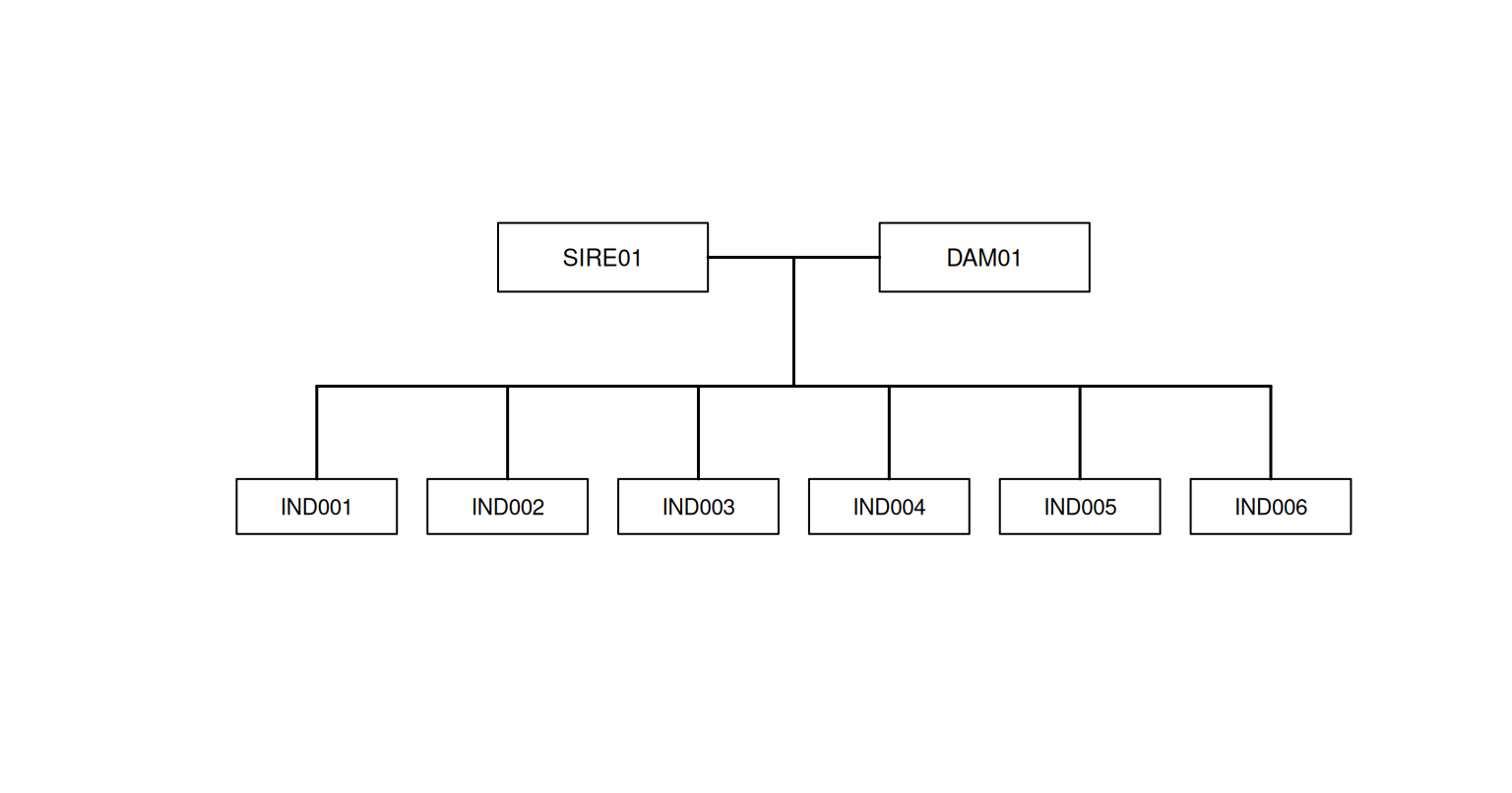
Figure 1 shows a readable subset of this recorded family. Every box is sex-neutral because the pedigree table records parent roles as sire and dam but has no separate sex field. The horizontal line joins the two recorded parents, and every vertical line shown leads to one of their offspring. The other 14 offspring have the same two recorded parents and are listed in the output above.
Figure 1: A readable six-offspring subset of the simulated principal family. SIRE01 and DAM01 are the two recorded parents of IND001 through IND006; the R output lists the remaining 14 offspring with the same parent pair. Boxes are intentionally sex-neutral because no sex field is supplied in d$pedigree.
The diagram records expected paths of descent, not the exact lengths of DNA segments that each offspring inherited. Full siblings share the same parents, but each receives a different realised mosaic of parental chromosome copies.
Inbreeding and homozygosity
Inbreeding occurs when the two allele copies in an individual are more likely to trace to the same ancestral copy because its parents are related. It increases expected homozygosity, the state of carrying matching alleles at a locus. A homozygous genotype need not be IBD, because the same allele state can occur independently in the population. Conversely, inbreeding is an ancestry-based probability that may be estimated using pedigree or genomic information.
Increased homozygosity can expose recessive deleterious alleles that were masked in heterozygotes. The resulting average reduction in a trait associated with survival, fertility, growth, or another fitness-related measure is called inbreeding depression. It is a population-level possibility, not an automatic diagnosis for one individual with a related pedigree. Its magnitude depends on the trait, the population’s deleterious variation, its breeding and demographic history, and the environment.
Pedigrees give a biological map of ancestry. The next page asks a different question: when a phenotype varies among relatives, how many loci and biological pathways may contribute to that variation?
Exercises
Under the stated non-inbred pedigree assumptions, why can full siblings have the same expected sharing as a parent and offspring but different realised chromosome segments?
NoteSolution
Both relationships have expected autosomal sharing of one-half. A parent transmits a recombined chromosome copy to each offspring, and two full siblings receive separate meiotic samples from both shared parents. Their actual inherited segments can therefore differ despite the same expectation.
Two individuals have matching alleles at a marker. Why does this not by itself show that the copies are IBD or give their kinship coefficient?
NoteSolution
Matching observed states establish IBS at that marker. The match may arise without a shared ancestral copy, especially for a common allele. IBD and kinship require information or assumptions about ancestry, not only one matching genotype.
What does the principal-family diagram establish, and what does it not establish about the six displayed offspring?
NoteSolution
It establishes the recorded pedigree links: SIRE01 and DAM01 are parents of each displayed offspring. It does not show their exact realised genome sharing, the parental origin of every allele, or whether any individual has inbreeding depression.