masgenomics
Genomic prediction with SNP and microhaplotype data





Two R packages, one Rust backend. SNP + microhaplotype markers, REML and Bayesian estimators, continuous and binary traits, all through a single API surface.
Welcome
MasBayes and MasRemL were developed to make genomic prediction more flexible and reproducible. These packages support multiple methods, including REML-BLUP for frequentist-based methods and the Bayesian alphabet for Bayesian statistical methods. The packages also work with two marker types (SNPs and microhaplotypes) and can analyse both continuous and binary traits.
All features are integrated into a single R environment with the Rust backend, shared demo datasets, and a consistent API. This allows the same analysis pipeline to run from start to finish without changing tools, programming languages, or input formats during the analysis.
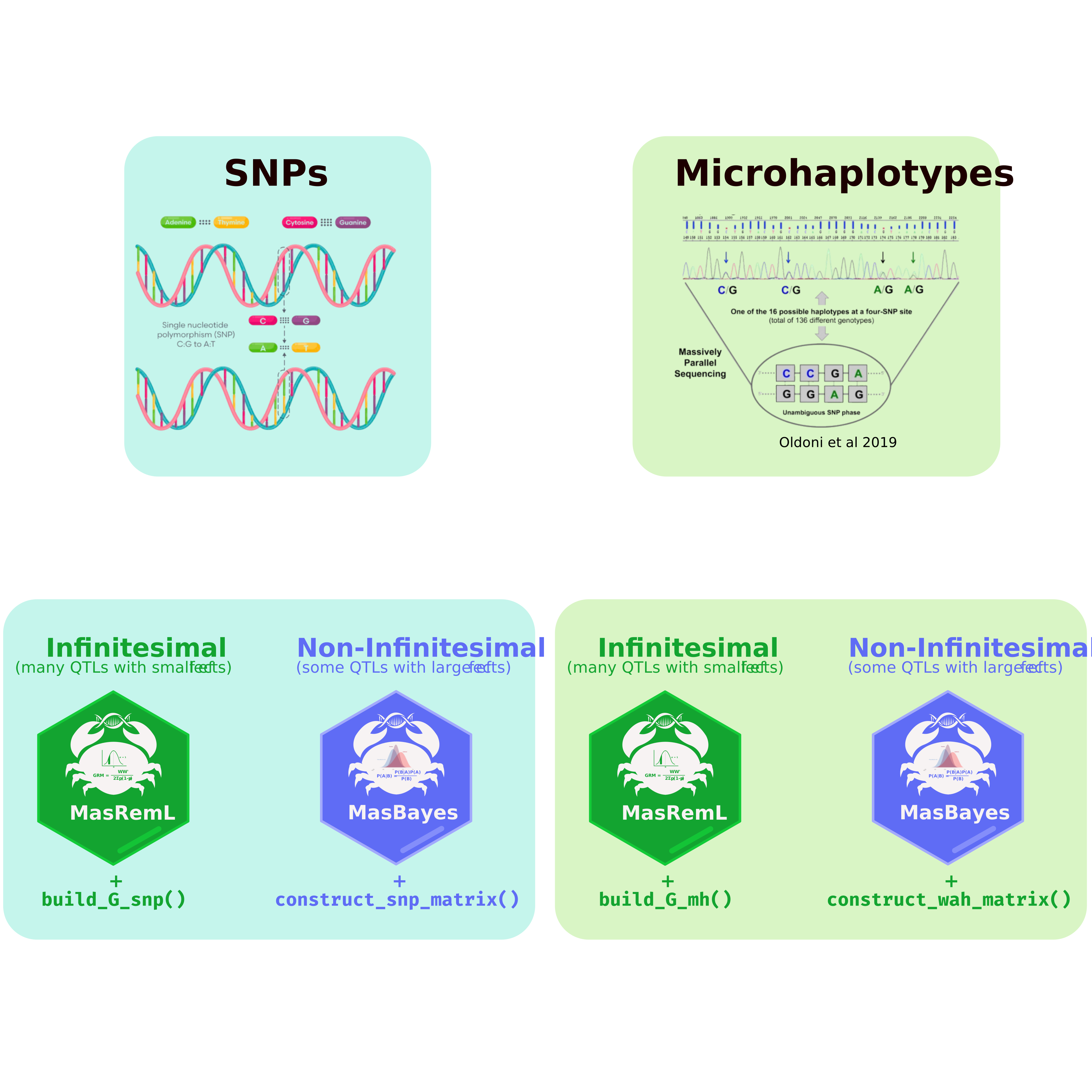
Over the last few years, many great scientists have developed outstanding algorithms, prediction models, etc, but often rare of them share the source codes directly for reproducible analysis. Hence, this project is open source and free, so anyone can reproduce the same results, as well as providing evaluation and improvement for MasBayes and MasRemL. Through this project, we also plan to develop more prediction models and algorithms within the two frameworks, BLUPs & Bayesian, to answer current challenges in genomic selection, such as genetic marker relevance, EBV calculation for cross population or generation, and GxE interaction.
The lead developer has only been learning and implementing Rust for over four years, mostly for the backend of websites or desktop applications, and yes, this is the largest Rust project we have ever built for the purpose of end-to-end genomic selection, specifically based on multi-allelic markers. Indeed, Rust is not widely used as a backend for many current R packages (most use C++), but this is a good opportunity to introduce Rust as a memory-safe programming language for processing large genomic datasets.
Within the MasBayes or MasRemL, all heavy numerical operations, such as variance component estimation, Gibbs sampling, and solving linear algebra in a dense matrix, are calculated within the Rust kernel, while you only face the R frontend with very simple syntax. The concept of ownership from Rust ensures that you can calculate all of those heavy operations without wasting computing resources. This is our motivation to build a system that enables anyone with limited computational resources to learn and use genomic tools for selective breeding in a very efficient way.
See Installation for how to set up Rust and both packages on Linux, macOS, and Windows.
Where to go next
| You are… | Start here |
|---|---|
| Setting up for the first time | Installation |
| Looking for code examples | Tutorials → Genomic Prediction |
| Learn more about genomic selection | Theory |
| Looking for input-data formats and the bundled demo | Input Data |
| Looking for function docs | Reference → masreml · masbayes |
| Curious about the Rust internals | Internals |
Citation
If you use these packages, please cite — see CITATION.