A SNP genotype says which two alleles an individual carries at one position, but it does not necessarily say which alleles occur together on either copy of a chromosome. That missing information matters when a breeder wants to follow a chromosome segment through a family, interpret a local association, or represent several nearby variants as one marker. The previous page showed how recombination and linkage disequilibrium shape associations between loci. This page follows the allele combinations on individual chromosome copies.
A genotype is not always a phased chromosome pair
A haplotype is the combination of alleles carried on one chromosome copy over a region. A diploid individual carries two haplotypes in that region. Its multilocus genotype records the two alleles at each locus, whereas its phase records which alleles share a chromosome copy.
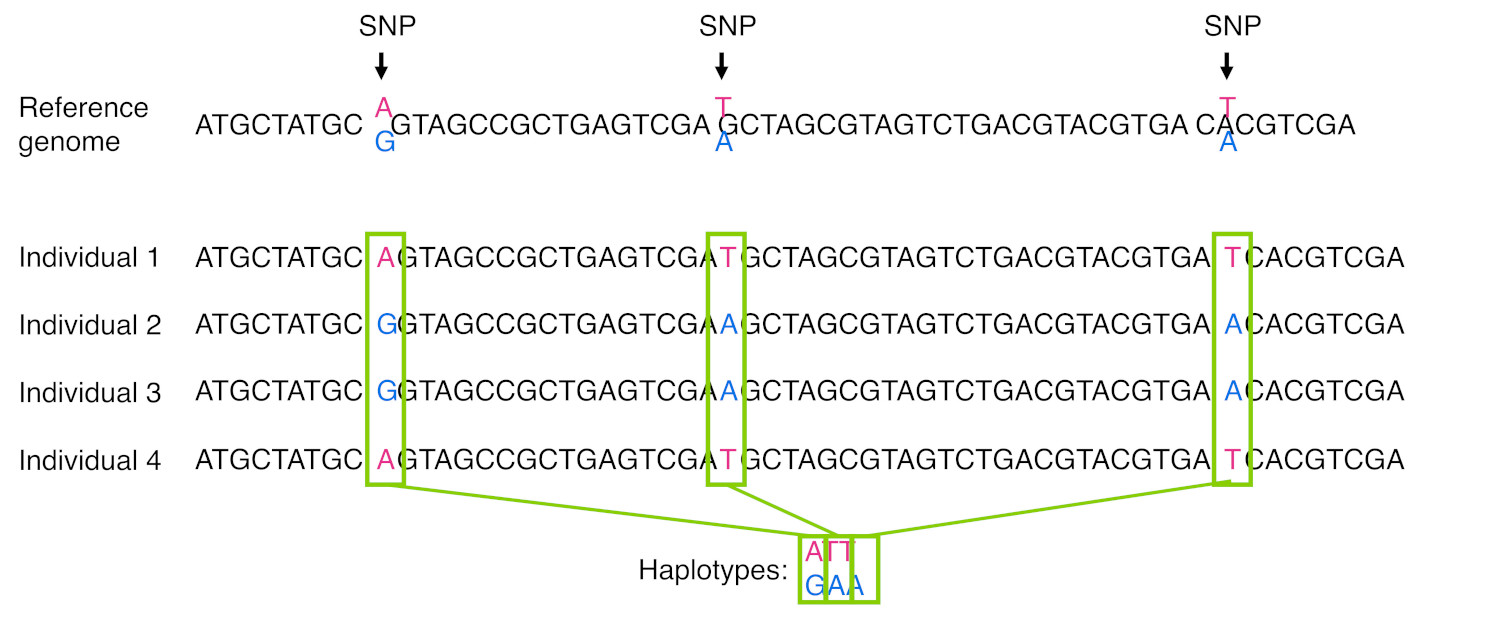
Figure 1 shows this grouping across three SNP positions. The four displayed sequences contain two recurring allele combinations, ATT and GAA. Each combination is a haplotype in this short region. The reference sequence provides a comparison row, while the individual rows show which combination is observed. The figure is a conceptual population example, not a record from the simulated project data.
Figure 1: A reference genome sequence and four individual sequences are compared at three highlighted SNP positions. Green boxes connect the recurring ATT and GAA combinations to two haplotype labels. Amanda Simons, source, CC BY-SA; unchanged.
Consider an invented individual that is heterozygous at two loci, A and B. Both chromosome arrangements below give the same unphased genotype, A/a, B/b. They are not the same phased haplotype pair.
Arrangement
Chromosome copy 1
Chromosome copy 2
Unphased genotype
Coupling phase
A at locus 1, B at locus 2 (AB)
a at locus 1, b at locus 2 (ab)
A/a, B/b
Repulsion phase
A at locus 1, b at locus 2 (Ab)
a at locus 1, B at locus 2 (aB)
A/a, B/b
This is phase ambiguity: genotype observations alone leave more than one haplotype pair possible. The difference is visible if the individual produces gametes. Without recombination between the loci, the coupling arrangement can transmit AB or ab, while the repulsion arrangement can transmit Ab or aB. A crossover between the loci can instead create the other combinations. Thus, parental haplotypes help trace transmission, but recombination means that a longer parental haplotype need not pass intact to every offspring.
Phasing is the process of assigning alleles to the two chromosome copies. Statistical phasing uses recurring allele combinations in a sample or reference population to choose likely haplotype pairs. Pedigree-assisted phasing also uses the alleles observed in parents, offspring, and other relatives to constrain what could have been transmitted. Both approaches depend on the information in the data: a small, unrelated, or poorly matched reference population can leave uncertainty, and a sparse or erroneous pedigree can limit family-based inference.
A phasing error assigns part of a chromosome to the wrong haplotype copy. A common form is a switch error, where the assignment changes from one inferred copy to the other between adjacent positions. It can make a continuous haplotype appear to break, or create a combination that was not inherited as shown. Phased results are therefore estimates or observations with a method and an error rate, not automatic proof of parental origin.
Blocks summarise local haplotype patterns
A haplotype block is a useful summary of a local region in which a limited set of haplotype patterns is observed or represented. Blocks are not immutable units marked on the genome. Their boundaries and the haplotypes retained depend on the population, marker set, sample size, LD criterion, and algorithm used to define them. Recombination history can make a block defined in one population less useful in another population or generation.
A microhaplotype is a short region (less than 150 bp) represented by the combination of nearby variant alleles on a chromosome copy. Because several component variants can form several local combinations, it is a multiallelic marker even when its individual SNPs are biallelic. This representation retains local co-occurrence information that separate unphased SNP genotypes can obscure. It can be informative when the local haplotype state distinguishes chromosome segments that have the same single-SNP summaries.
That potential does not make microhaplotypes universally better than SNPs. Their observed diversity, phase quality, marker-QTL association, and transfer across populations depend on the region and population. A microhaplotype does not guarantee a stronger prediction, fewer markers, or an association that survives recombination and population change. This page describes the biological representation only; the microhaplotype input guide defines the file layouts and software-ready objects.
A compact microhaplotype view from the simulated data
The project data are simulated. In their compact representation, each block has two columns, one for each chromosome-copy haplotype. block_3 spans 1.4 to 1.5 Mb on chromosome 1. The code extracts its map row and the two columns for the first six individuals.
Code
d<-readRDS("../../demo-data/main/demo_data.rds")block_3_map<-subset(d$map_mh, block_id=="block_3")block_3_columns<-which(attr(d$mh, "block_id")=="block_3")block_3<-d$mh[1:6, block_3_columns, drop =FALSE]colnames(block_3)<-c("copy_1", "copy_2")block_3_map
The map confirms chromosome 1 and the 1.4 to 1.5 Mb interval. In this six individual teaching view, the compact identifiers are 4, 7, and 8. They name three haplotype categories in this two-SNP block; 8 is not biologically larger, more favourable, or more frequent than 4. The copy_1 and copy_2 columns represent the two haplotype copies for each individual. Their column order is a storage convention here, not evidence that copy_1 is paternal or that copy_2 is maternal.
The compact identifiers are convenient for the project data, but they do not by themselves reveal the component alleles. They should not be treated as a numeric measurement in an analysis. To inspect the component-SNP calls, encoding, or software inputs, use the linked input-data guide rather than inferring a schema from this teaching view.
What phase can and cannot establish
Phase can show a proposed or observed arrangement of alleles on chromosome copies, helping to follow local transmission and represent multi-allelic markers. It does not establish that a haplotype causes a trait, that a block is permanent, or that one inferred copy has a parental origin when the data do not establish it. The next topic asks how chromosome segments are shared among relatives, where family records and inheritance paths add information that a single individual’s genotype cannot provide.
Exercises
An individual has unphased genotype A/a, B/b. Name the two haplotype pairs shown in the manual example that could produce this genotype.
NoteSolution
The coupling pair is AB/ab, and the repulsion pair is Ab/aB. Both have one A and one a allele at the first locus and one B and one b allele at the second locus, so the unphased genotype alone cannot distinguish them.
Why can recombination make an offspring’s haplotype different from either intact parental haplotype?
NoteSolution
A crossover between loci can join one part of one parental chromosome copy to the corresponding part of the other copy. For example, a parent with AB/ab can produce Ab or aB when recombination occurs between the two loci.
What do the identifiers 4, 7, and 8 mean in the block_3 teaching view, and what would be an invalid interpretation of their order?
NoteSolution
They are category labels for compactly encoded haplotype states in this two-SNP block. It would be invalid to treat 8 as a larger allele dosage, a better haplotype, or a value that can be averaged with 4 and 7.